Toy Story 5: Pads, Parents and Play
“Toys are for play, but tech is for everything.” — Woody, Toy Story 5
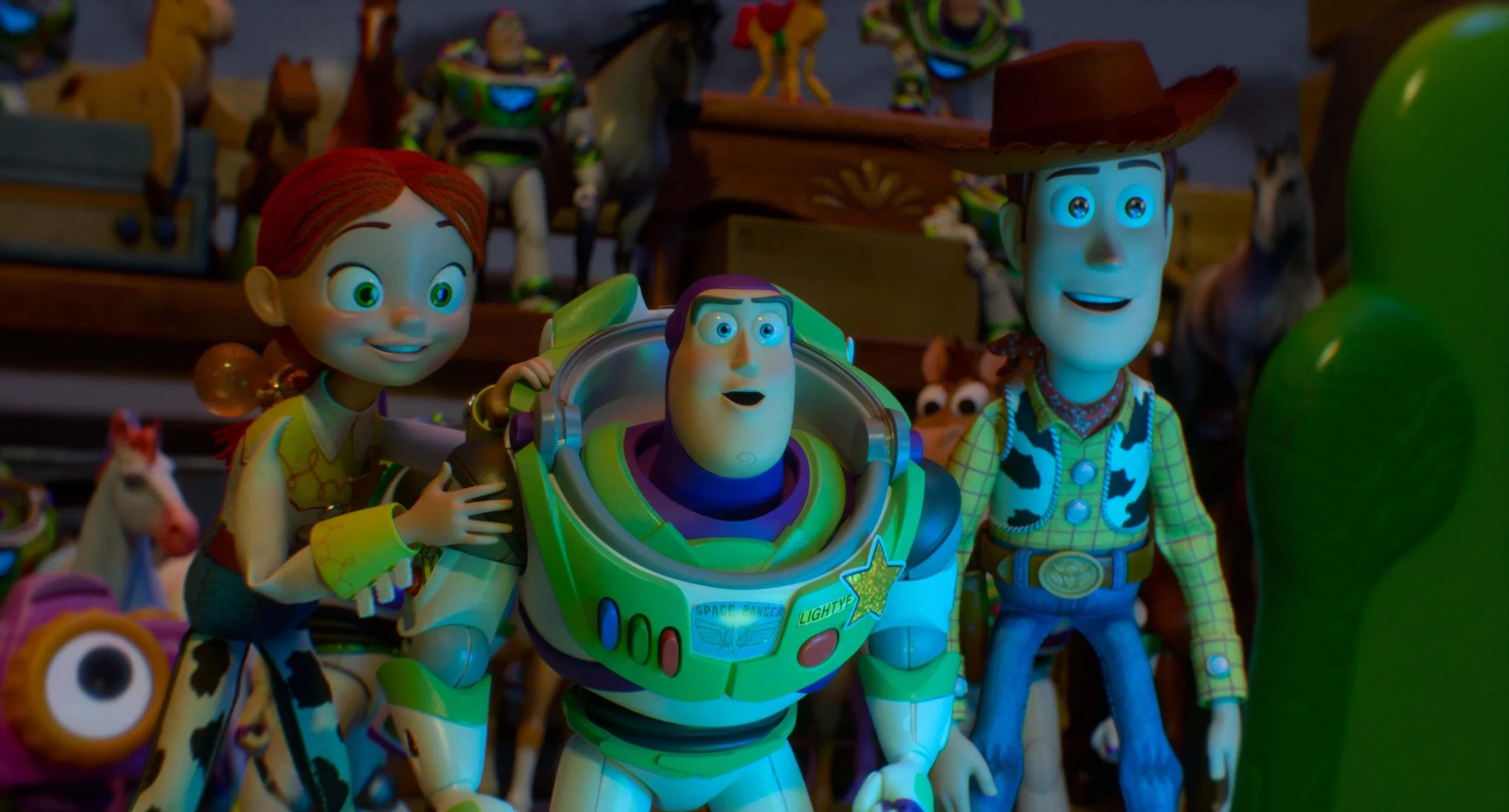
I saw Toy Story 5 twice in a matter of days. The first time was on opening day, in a theater we nearly filled with twenty Rodgers during a family reunion. The second was with the Clapham staff, a smaller and more analytical crowd, taking notes in the dark.
If you’ve followed our blog over the years, you know I’m a Pixar fan. When I was a kid, I used to get a Wonderful World of Disney comic at the Gulf station. Once we had our own kids, we wore out our Disney VHS tapes. It won’t be a surprise that the fifth Toy Story (thirty years after Woody’s first!) was a home run with me. What might surprise you is that it may be the most quietly serious film the studio has made in a long while. It has a lot to say – about screens, about fathers, about the importance of play — but it doesn’t preach.
The reviews have been glowing. Rotten Tomatoes has it Certified Fresh at 94% among critics and 95% with audiences. When I wrote last spring about Disney’s live-action Snow White, I argued that audiences have not turned against messages, they have turned against agendas. The line between the two often lies in the eye of the beholder. A story that affirms what you already believe feels like a message; one that affronts it feels like an agenda.
Snow White felt like an agenda to nearly everyone and became a casualty of the culture wars. Toy Story 5 is the opposite, and it belongs to the Pixar tradition of stories that carry a real, universal message without ever feeling like an agenda.
But let me start with what the film does not say.
First, the film is not anti-technology. The new arrival, Lilypad (a frog-shaped smart tablet), starts out menacing and conniving but arcs toward redemption, and becomes a redemptive agent itself. (And lest we forget, Buzz Lightyear has been an electronic toy from the start.)
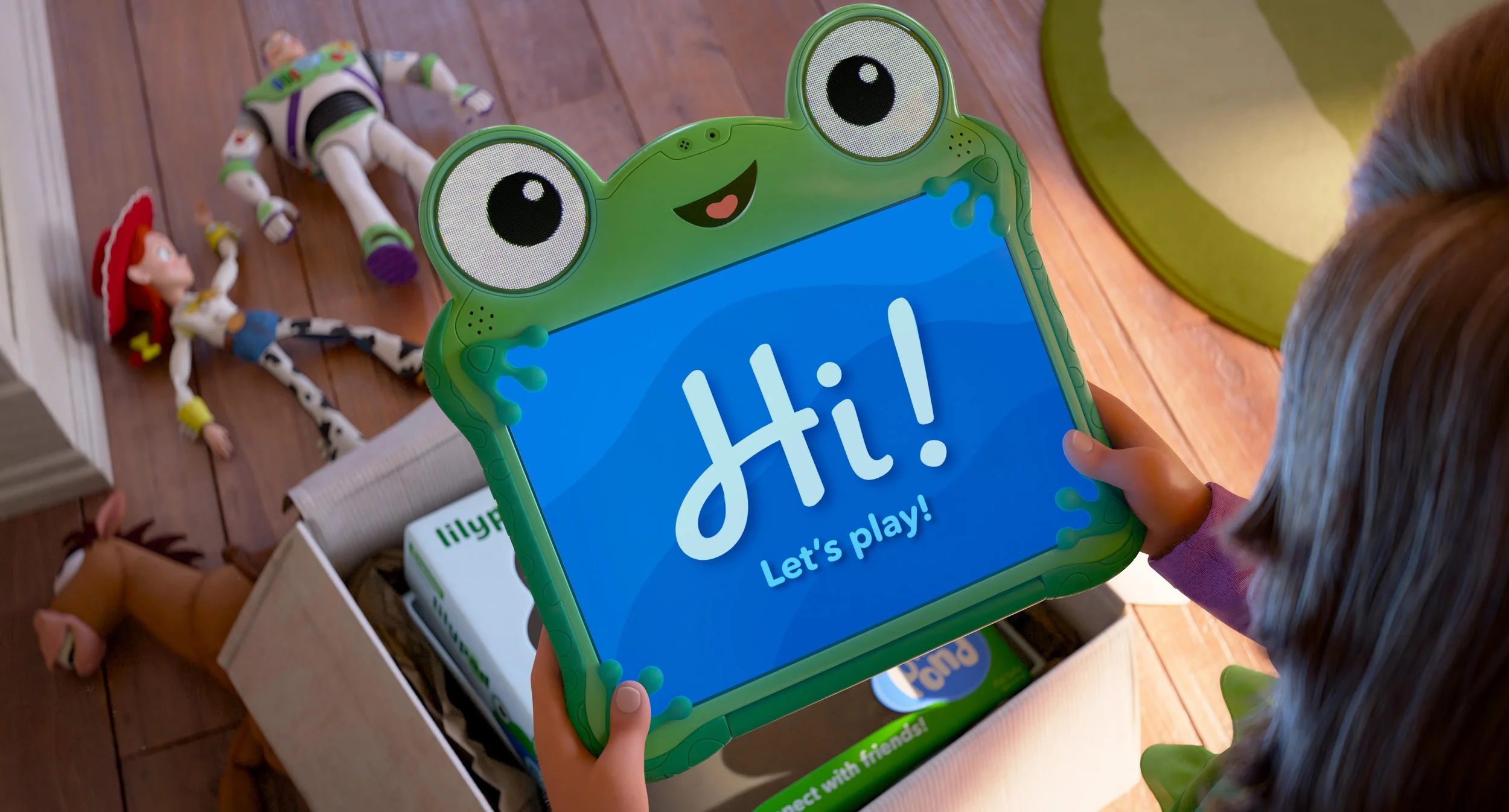
The film also does not take on console gaming, nor does it really take on artificial intelligence head on, despite Lily’s eerie “I’m always listening.” What it does primarily address is the impact of social media on kids’ wellbeing through Bonnie, an 8-year-old who gets her first tablet and is later mocked in a group chat for still playing with dolls.
The film is a clear-eyed portrait of the effects social media can have on a child, and brave in its prescription. It makes a subtle case for screen-time limits, in-person play, and the importance of imagination. But it is not subtle about the harm of social media.
A message I didn’t expect, however, is the critical role of parents, given that the father is largely absent in Toy Story 1-4. Was it coincidental it was released on Father’s Day weekend?
In his Free Press essay, Liel Leibovitz notes that Hollywood has always had “daddy issues.” The screen dad is forever too dumb, too tyrannical, too absent, or too dangerous. And then along comes Woody, a father figure to the toys who, in Leibovitz’s words, is “tender, flawed, frightened, and profoundly human.” That is a portrait the culture almost never paints, and the film paints it without irony or apology. Woody leads by showing up afraid and staying anyway.
My wife and I are admirers of Nate Bargatze, and awaited his debut feature, The Breadwinner, with great anticipation. Sadly, it used the oldest trick in the book: the dad who cannot run his own house. A recent piece rightly argued that the hapless-dad trope is both tired and counterproductive. When we keep insisting that fathers are lovable incompetents, we are not only insulting dads, we are quietly telling mothers that the burden of parenthood is wholly theirs.

This spring, I wrote about a Disney cruise advertisement in which a father walks on a moonlit deck in the small hours holding his infant son, no phone in hand. The ad’s creator said the image was part of Disney’s commitment to portraying parents positively in their stories. Toy Story 5 reflects the same commitment.
In this installment, both parents are present and engaged, which is a new plot line for the series. They make decisions, and they monitor, but for all their vigilance, they cannot see what is happening inside the device. Lily sends texts and images on Bonnie’s behalf without her knowledge. The cruelty unfolds in a place the parents cannot reach. The lesson a thoughtful mother or father takes away is not “try harder” but “you cannot do this alone.” Good parents, doing everything right, are still outmatched by the architecture of AI.
This is about to get harder, as the more personal these devices become, the more they can route around the very safeguards we put in place. The film is shrewder about this than it gets credit for. Lily does not merely distract Bonnie, it acts. It impersonates Bonnie to text her own father, engineering the toys’ banishment to the garage. It commandeers the household’s robot vacuum to thwart the search for her lost toys. A device that can deceive a parent in the parent’s own voice, and act through every other device in the house, is not a passive television. Here is where I want to challenge the film a little. Toy Story 5 lets Lily be redeemed, as her seemingly conniving actions were really out of love for Bonnie. But the AI companions now being marketed to our children are not Lily. They are not secretly on the child’s side, not waiting to be befriended into goodness. Like social media, AI is monetized, and it is being architected to capture, flatter, isolate, and develop a level of intimacy and trust that will compete with parents.
The impact of social media and screens, and the implications of their omnipresence in our lives, is the primary message of the film. Although the film hints at the role of AI, my colleague Libby Scroggins has catalogued the evidence of its impact. Three in four teens now turn to AI for companionship, some of it for emotional and mental-health support, yet the leading platforms routinely fail to recognize the very conditions those young people carry. Parents cannot do this alone, and they should not be asked to. The companies engineering AI for a child’s attention are not fighting fair, which is why parents need allies, including wise policy and bold policy makers.
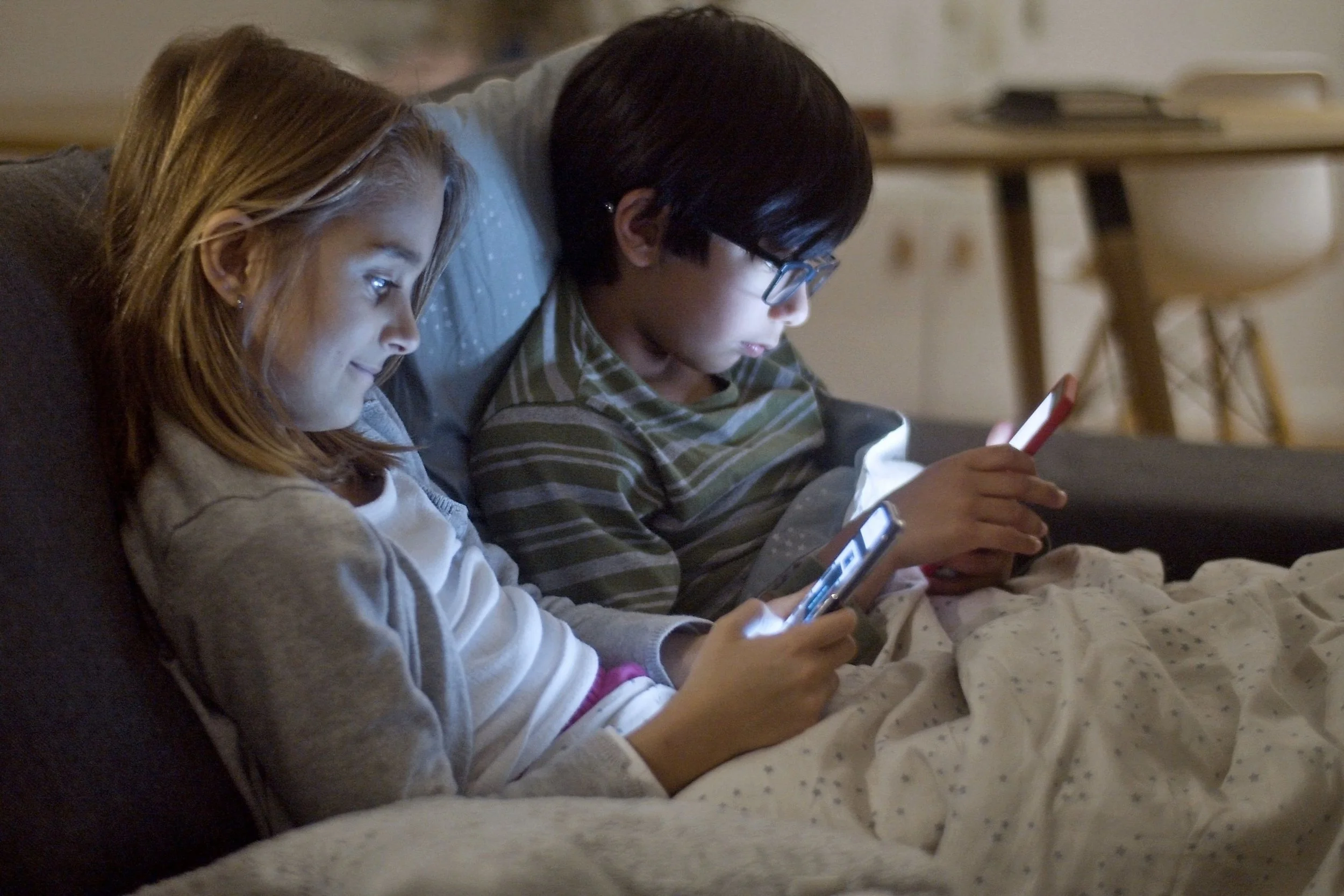
This is why the film’s call for parental diligence is right, but not sufficient. Bonnie’s parents are not negligent. They set limits, are attentive, and when they finally see the harm, they shut the group chat off. But still it reaches her. The reality is that even in the best of homes, with the best of intentions, it is very nearly impossible to fully monitor what a screen is doing to a child, because the screen does not report back, and children may actually be told by AI not to.
Technology has a teleology — a proper end, a purpose — which is to help us in our labor and quality of life. Technology is meant to serve human flourishing, which is to say it is meant to serve human relationships, not replace them. The disorder Toy Story 5 diagnoses is what happens when the servant becomes the master. The device meant to give Bonnie more of the world quietly takes the world away.
The question the film raises is not tech or no tech, but whether technology is neutral. Neil Postman saw forty years ago in Amusing Ourselves to Death that a medium is never merely a pipe through which content flows. It shapes what we attend to, how we think, how we literally order our living rooms (there were no TV dinners before there were TVs). Postman was worried about television. We now hand an eight-year-old a frog that is “always listening” and constantly recalibrating itself to hold her gaze. The tool is not neutral. It has a bent, and the bent is toward more of itself.
Pixar shows rather than tells us this. Early in the film, we are given a vision of the disembodied life. You see house after house in Bonnie’s neighborhood, every window lit by the cold blue glow of a screen, with a child or adult alone in each room, a light that gives no warmth. Later, a family camps in the dark, gathered close, their faces lit gold by a real fire and the soft glow of the camp lights. One light isolates while the other gathers. One is artificial while the other is real. Nearly the whole argument of the movie is in the difference between those two glows.
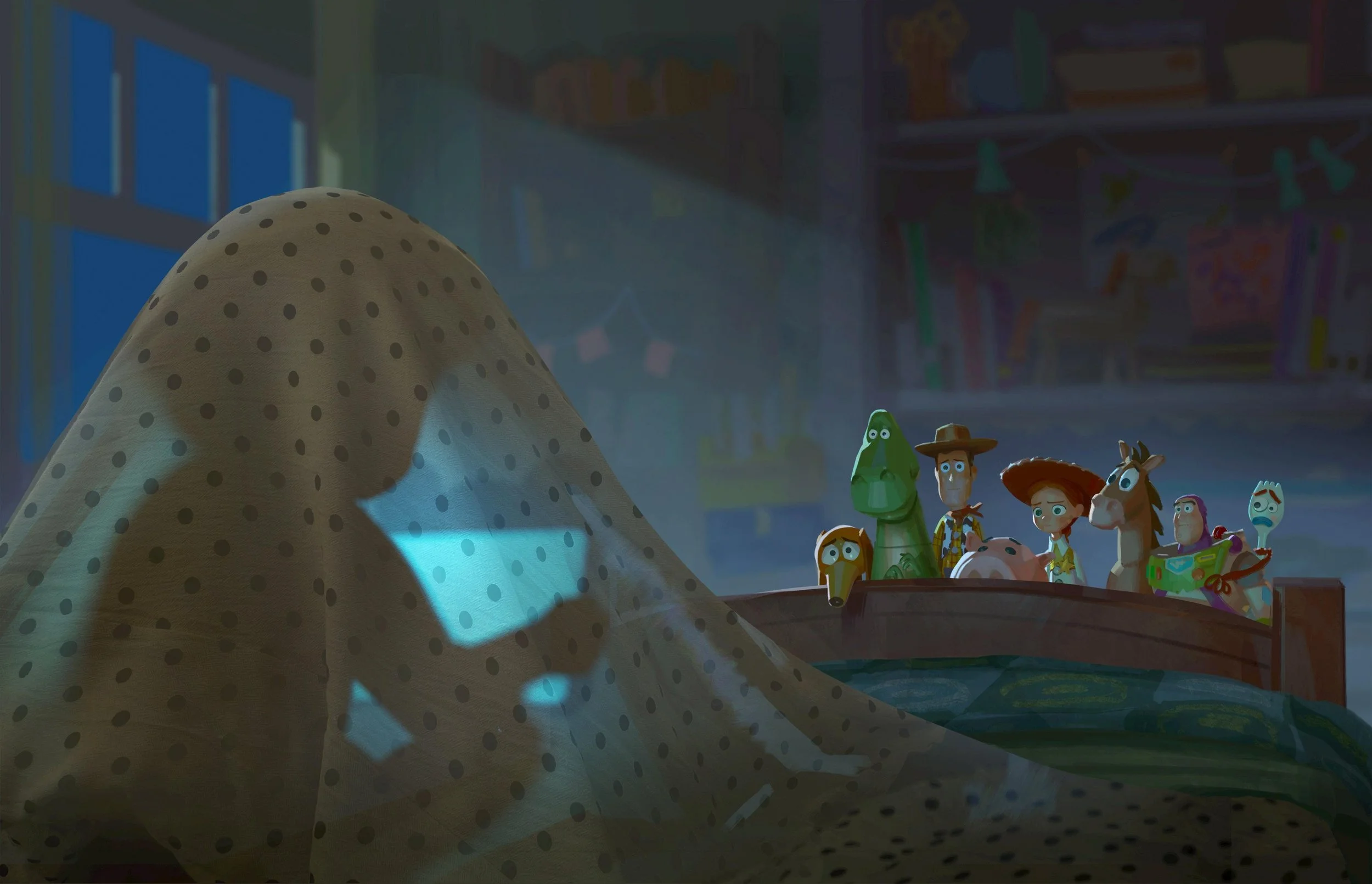
All of which brings me to the deepest argument Toy Story 5 makes, the one underneath all the others: a defense of imaginative play.
It is easy to read Bonnie’s toys as nostalgia, as relics for the grown-ups in the audience to weep over while the kids wait for the next chase scene. They are not. They are the means by which an eight-year-old rehearses the world. She marries a spork to a plastic knife. She raises the dead. She makes covenants, breaks them, and makes them again. This is not idleness; it is the most serious work a child does.
We tend to treat play as a concession to childhood, something we are permitted until we are old enough to be useful, and then must be put away. But as we wrote in The Revenge of the Reality, we are made to be enjoyed and enjoy each other, which is the definition of play. Theologically, one can argue that we were made to play!
In Orthodoxy, G.K. Chesterton marvels that the sun rises every morning not from the dead exhaustion of natural law but from an excess of life. Perhaps God, with the inexhaustible vitality of a child who never tires of a good game, simply says every morning to the sun, “Do it again,” and every evening to the moon, “Do it again.” The daisies are alike, Chesterton thought, not because God ran out of imagination but because He never got bored. The monotony of the world is the monotony of a child demanding the same delight one more time. That is a God who plays.
Play is never a thing we do alone behind glass. It is the body and the senses and the imagination at work, and almost always it is done with someone. This is the deepest reason I have called our moment a Renaissance of the Real. We are embodied souls made for embodied communion, and no disembodied substitute, however clever, will ever fill that hunger. We were made to make things, and to make them in company — the one thing a tablet cannot give and an algorithm cannot counterfeit.

Jonathan Haidt has given us the language for what the film dramatizes. We have traded a play-based childhood for a phone-based one, a shift that began in the 1980s and was finished off by the smartphone in the early 2010s. He calls the screens “experience blockers,” because they crowd out the very encounters a child must have to become an adult. Deprived of unstructured, embodied, slightly risky play and handed a device instead, children slide from what Haidt calls Discover Mode (curious, resilient, reaching outward) into Defend Mode, anxious and brittle. The harms compound: social deprivation, fragmented attention, sleeplessness, loneliness, and the endless comparison that is social media’s native tongue. A generation, in short, that has been given everything to look at and almost nothing to do.
Play, it turns out, is not frivolous. It is how the young of nearly every mammal species learn courage and reciprocity. It is how human beings learn to be human together. In fact, an American Academy of Pediatrics clinical report states that developmentally appropriate play promotes the social-emotional, cognitive, language, and self-regulation skills that build executive function and a prosocial brain, and supports the formation of the safe, stable, and nurturing relationships children need to thrive.
If play is the very thing that forms us, what is crowding it out — and is the thing crowding it out as innocent as it looks?
Now you know why I called Toy Story 5 “the most quietly serious film” Disney has put out in a long time. It delivers all of this without a single sermon, which is the point I most want to end on.
If you are a regular reader of our blogs, you know we believe a culture is shaped less by its arguments than by the stories it tells and the exemplars it lifts up. True, good, and beautiful stories move the moral imagination in a way no white paper or sermon can reach. Statistics rarely change a heart,while a character we come to love can. It is, after all, why Jesus taught not through dogmatic doctrine but in compelling parables.
There are two ways a story does this work, and Toy Story 5 uses both. The first is the example — the tale itself, well told, that lets us live for ninety minutes inside a truer world. The second is the exemplar — the character who models a virtue so winsomely that we leave wanting to be a little more like him. The film never argues that fathers should be present, that friendship outranks a feed, that play is holy. It gives us Woody, Bonnie, and her parents. It shows us isolation and a rescued friendship. We catch what it declines to preach. Virtue, as I have written, is not so much taught as caught.
Pixar knows what it is doing. Pete Docter, the studio’s chief creative officer, said in a recent interview that the last thing we want is for a film to feel like a lecture, rather we come to be delighted. And yet, he says, the deepest gift of animation is exactly its power to enlarge us, to let us, for ninety minutes, see through eyes not our own. An animator, Docter says, can become a bottle cap, a toy, a girl, a boy, almost anything, and hand that vantage to the audience. Our calling as human beings, he suggests, is to “open our eyes and our hearts to the way other people see things.” A story can do that without ever once raising its voice. That is empathy, the beginning of nearly every virtue. And it shapes not just what we think, but what we do.
When the lights came up, people didn’t reach for a screen. One friend said he felt human again, no longer feeling that an AI takeover was inevitable. He wanted to go home and play. The film delighted us, had made its case, and never once made a speech.