Disney Cruise and Positive Virtue Signaling
Culture may even be described simply as that which makes life worth living. And it is what justifies other peoples and other generations in saying, when they contemplate the remains and the influence of an extinct civilization, that it was worthwhile for that civilization to have existed.
– T. S. Eliot, from Notes Towards the Definition of Culture
"Virtue signaling" has become one of the most reliable applause lines in conservative discourse. But what if conservatives have been too quick to mock the concept, and in doing so have undermined one of the very ways cultural values should be transmitted and shaped?
T.S. Eliot, in his 1948 essay collection Notes Towards the Definition of Culture, argued that culture is not an intellectual achievement separate from daily life. It is an organic whole in which beliefs, habits, liturgies, and art are woven together in ways that cannot be disentangled without tearing the fabric itself. Culture is not what we profess in policy papers; it is what we practice at dinner, celebrate in public, and model for our children. If Eliot is right, the question isn't whether we want institutions to signal virtue to society, the question is how we encourage them to signal more.
This is the frame through which I've been thinking about a Disney cruise line advertisement that has apparently been watched by roughly 40 billion people – at least according to Liel Leibovitz at The Free Press, who wrote about it this week. A father and his infant son wander a moonlit cruise ship deck in the small hours. The ship is quiet. The world narrows to what matters. It is, Leibovitz argues, a radically traditional vision of American life that the broader culture abandoned decades ago.
He's right. And it connects to something we've been tracking at Clapham for years: both a cultural value worth affirming, and a means by which values are transmitted to culture.
We've written twice now about Walt Disney World as a cultural bellwether. In 2019, after a trip with our family, I wrote about how Disney's Main Street was America's Main Street. Families of every background waiting together, cast members setting a tone of genuine hospitality, and the Hall of Presidents offering an unambiguous celebration of the American experiment.
But something else happened on that trip that has stayed with me. The park was clean. Immaculately, almost improbably clean. And the behavior of the guests reflected it. People held doors. They apologized when they bumped into one another. They watched their language. One cast member, seeing our exhausted grandchildren melting down in the heat, brought them complimentary ice cream without being asked. The generosity of spirit was, as I wrote at the time, contagious.
The park's order and cleanliness affirmed the "broken windows" theory to me. We were all living out our better angels because it appeared everyone else was as well.
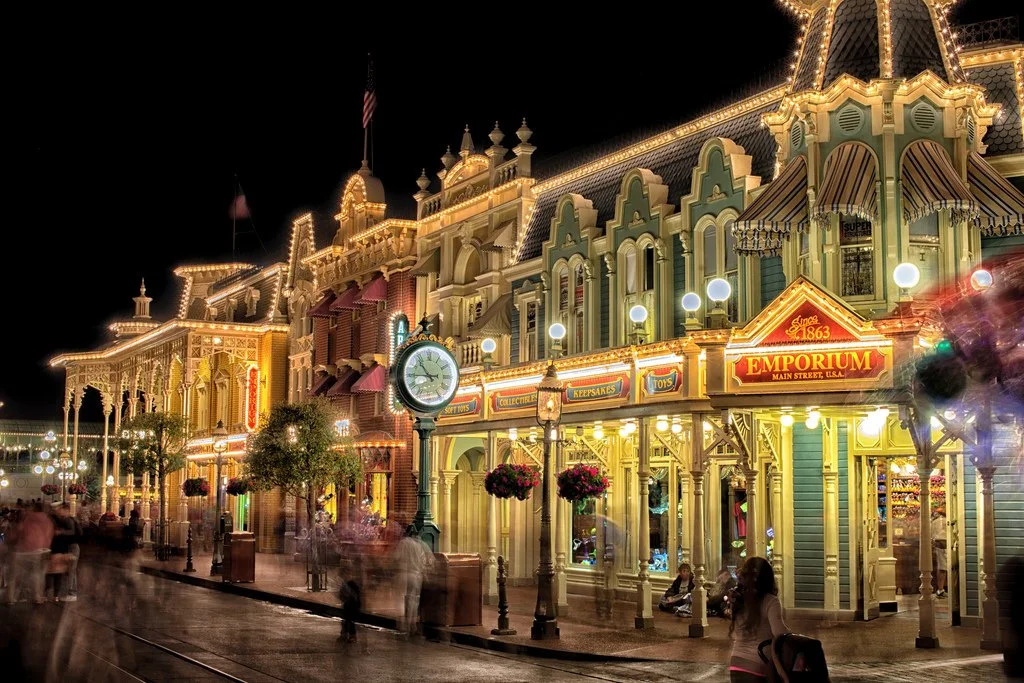
Broken windows theory, developed by criminologists James Q. Wilson and George Kelling in 1982, held that visible signs of order and care in a community signal that norms are being maintained and enforced. A repaired window, a clean sidewalk, a neighbor who bothers to pick up litter: these are not merely aesthetic choices. They are communications, a form of virtual signaling. They tell everyone who passes that this place is cared for, that someone is watching, that standards apply here. And people respond. The environment shapes the behavior, which reinforces the environment.
This has shaped my thinking about culture broadly ever since.The theory is usually applied to crime and public order. But its logic runs all the way up. Small signals, consistently sent, create the conditions in which certain behaviors become more natural and others less so. And these signals are being sent all the time, but through millions of transmitters, as Eliot suggests. What institutions choose to visibly celebrate – what they invest in, what they put in front of millions of people – are not merely aesthetic choices either. They are broken windows, in reverse. They are signals that certain things are worth maintaining, worth aspiring to, worth passing on.
From my perspective, Disney World is a masterclass in this. A couple of years ago, our staff decided to discover for ourselves how “woke” Disney had become. We visited the park, and spread out across the Magic Kingdom with scorecards, hunting for evidence of wokeness, patriotism, Judeo-Christian values, and Christmas. We found the parks quietly patriotic, gently traditional, and by almost every measure, a welcoming environment for families across the political spectrum. Based on the Pew Typology scale, our staff itself ranged from "Outsider Left" to "Committed Conservative,” and we nearly all reached the same conclusion: wokeness at 1.5/10, patriotism at 8/10, Judeo-Christian values at 7/10. What we also noticed was that the park was “signalling” virtues that we all wanted to see reinforced in a culture that was becoming – and has become – more toxic, hostile, and unwelcoming. Our conclusion was pointed: let the park lead the rest of Disney by example.
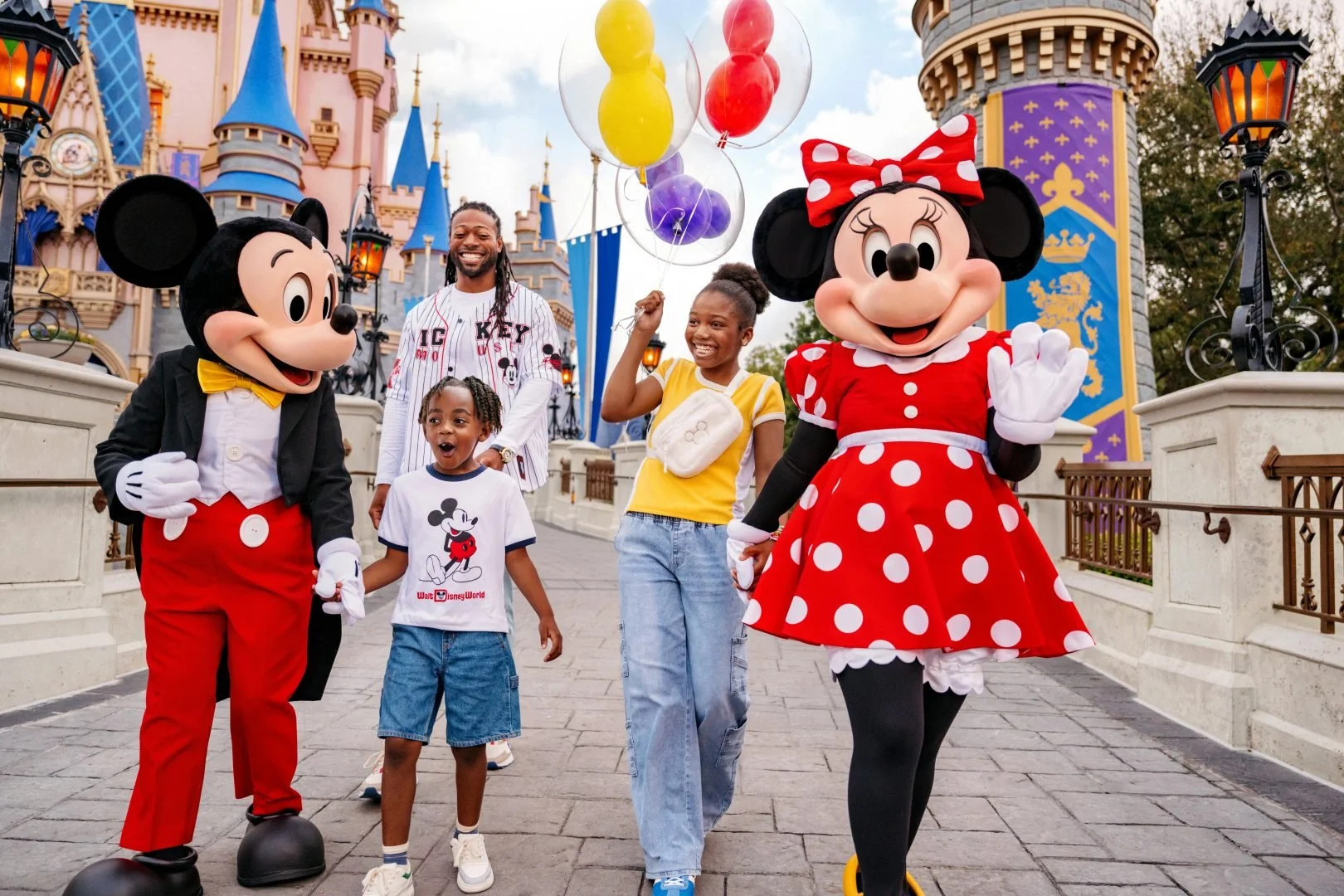
To be fair, those who have had legitimate grievances with some of Disney's content decisions are not wrong to raise them. As I noted in our reflection on Disney's live-action Snow White, there is a persistent gap between what the parks embody and what some of Disney's creative leadership seems determined to impose on its content. The parks understand their audience, some of the studios still don't.
Hopefully the cruise line ad suggests that the park's sensibility may be spreading.
What strikes me about the ad is that it communicates through compelling story and beauty, all in just one-minute-and-twenty-nine-seconds. This is another commitment of Clapham and our sister production company, More Productions. True, good, and beautiful stories shape the moral imagination and aspirations of both individuals and societies more than rational argument-making can. Statistics aren’t as persuasive as stories, from my own experience. This is why, as we have pointed out, Jesus didn’t teach through rhetoric, but with parables.
What the father does in that quiet hour is hold his child and walk with him, not scroll on his phone. This is counter-cultural, at a time when Boomers and Gen Xers are becoming increasingly distracted with screens, possibly more so than Millennials and Gen Zers – as a recent Washington Post editorial points out.
This is a portrait of intergenerational investment and a broken window repaired. It signals, to anyone watching, that this is what fatherhood looks like. It doesn't argue the point. It doesn't cite the data. It tells by showing, not telling.
That is virtue modeling in the Eliot sense: culture transmitted not through propositions, but through the accumulated weight of images, practices, and visible commitments. And intergenerational investment is not a progressive value or a conservative value. It is a foundational value, one that people across the political and cultural spectrum recognize when they see it, even if they reach it by different paths. Speaking from my own tradition, It Takes a Family (a phrase I have some personal affection for, having helped Rick Santorum develop its argument while serving in his Senate office).
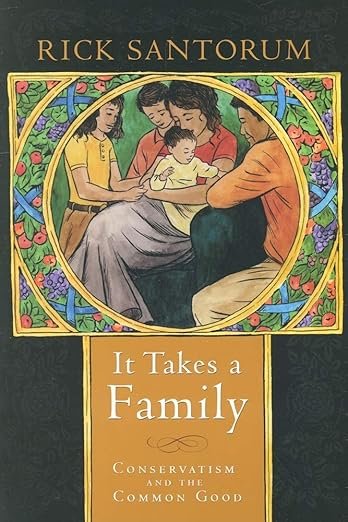
The book's core argument is that family is the irreducible unit of social flourishing. Fathers present at 2 a.m. Grandparents who show up. Marriages that hold. Extended families that gather. The data on what this produces for children in educational achievement, economic mobility, mental health, and relational stability is overwhelming and, across the ideological spectrum, increasingly undisputed.
This is why so much of Clapham's policy work focuses on marriage and family formation. And this is why we argued after the Super Bowl, when Bad Bunny surprised 100 million viewers by including a real wedding ceremony in his halftime show, that we should thank corporations and the cultural elite when they signal the virtue of family and marriage. The right instinct for people of any political persuasion who care about family stability was to celebrate what deserved celebrating, regardless of who was doing the celebrating or what political complications surrounded it. As I wrote at the time: "This isn't 'virtue signaling' in the pejorative sense we use today. It's virtue modeling. And like it or not, it's how cultural change happens."
The Super Bowl wedding was a celebration of both marriage and intergenerational culture: a couple's community, their family, their story, broadcast to a nation that desperately needs to see marriage elevated rather than merely argued for.
The Disney cruise ad is doing something similar. Neither example is a policy paper. Neither is a sermon. They are broken windows, repaired in public, in front of as many people as possible, signaling that certain things are still maintained here, still worth aspiring to, and still the norm rather than the exception. That signal is how culture actually shifts. Wilson and Kelling understood this about neighborhoods. Hannah More understood it about the aristocracy (as we’ve written about at Clapham, and as she herself argued in her book Manners of the Great). Walt Disney, at his best, understood it about the American imagination.
From my vantage point, I think the most culturally effective response to moments like these is straightforward – express appreciation. When a major institution puts a present father and his infant son on a moonlit deck without a cell phone in hand, that deserves public thanks, especially from those of us who spend considerable energy critiquing when these same institutions get it wrong. Conservatives need to offer a carrot, not just carry a stick. Cultural institutions respond to feedback. What gets celebrated gets repeated. That, too, is broken windows theory, applied to the incentive structures of corporate culture.
My wife and I have made a standing commitment to take each of our grandchildren (currently seven with our eighth due in a month) to Walt Disney World on their 12th or 13th birthday. It is a deliberate investment in memory and intergenerational time, and hopefully an object lesson in virtue. After watching that cruise line advertisement, I've started to wonder whether we should expand the tradition, perhaps through a family gathering on the Disney cruise line! Although I am not sure the pocket book for our growing family is big enough, as it happens, we have plans this summer for our first extended family gathering.
There's something appropriately “Eliot-ic” (if you will), and appropriately broken-windows about this. Culture isn't preserved through arguments, important as arguments are. It is preserved through the small, visible, repeated acts of care that tell those around us what we believe is worth maintaining. A clean park. A repaired window. A grandfather and his granddaughter waiting in line for Ariel. A father and his infant son on a moonlit deck. But it is also communicated top-down: through a Super Bowl halftime show, and a large corporate marketing campaign.
Virtue is not taught, it is caught. And virtue signaling, it turns out, is how we and the world are made.