Truth Matters Part 1: Is Truth Relevant?
“The public has a vital interest in receiving accurate, independent information about its government. No administration should restrict a news organization because it objects to its reporting.”
– Joint Statement by major media outlets in response to the White House decision to restrict some from the press pool
This month, an AI swarm of roughly 10,000 agents produced a proposed solution to the Navier–Stokes problem, one of mathematics’ seven Millennium Prize Problems, unsolved for nearly a century. Days later, researchers at the Geneva Centre for Security Policy warned at the World Economic Forum that the same kind of AI swarm technology is already being used to spread false and misleading content at machine speed, likely disrupting the global information ecosystem itself. One AI swarm converged on a truth precise enough to be formally verified, while another was released to make truth harder to find.
At one level, the pursuit of truth is as relevant as ever, but at the same time it apparently has become more elusive than ever. Can a nation built on the premise that some truths are “self-evident" survive this paradox, or will we be like Pontius Pilate, who asked, "What is truth?" and then walked away before pursuing an answer (John 18:38)?
Losing our shared confidence that truth is real and worth pursuing leaves a society only two options: coerce agreement, or shout past each other forever. The American project was built on the premise that some things are true regardless of who’s in power, and that free people arguing honestly could find their way to pursue truth together. Free speech wasn’t a nice-to-have personal freedom, but an essential component of society coming to agreement on what to pursue for mutual flourishing despite our inevitable disagreements. You cannot pursue truth you’re not allowed to question.
This is why the decision to block CNN, MS NOW, and Politico from the White House press pool is so dangerous.

I grew up in a house that treated truth-seeking as a vocation. My father was a systematic theologian who studied under Karl Barth, later served as dean of Trinity Anglican School for Ministry, and was eventually consecrated an Anglican bishop. Dinner-table conversation ran naturally toward questions the church spent centuries pursuing, such as “What can we actually say is true about the nature of the Trinity?” and “Should the Biblical creation account be taken literally?” The early ecumenical councils, Nicaea in 325 and Chalcedon in 451 among them, weren’t academic seminars but were rather the church trying, under real political pressure and sometimes real physical danger, to distinguish revealed truth from plausible-sounding heresy.
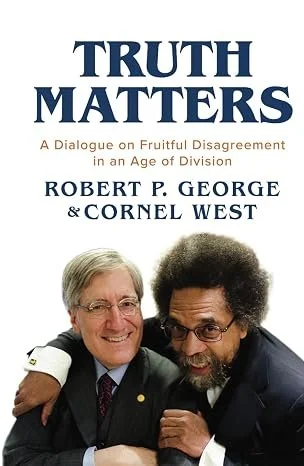
From my perspective, the pursuit of happiness requires a collective pursuit of truth, which requires civil discourse. Robert George and Cornel West have spent the last several years doing something almost no one thinks is possible: a Princeton conservative and a socialist Christian philosopher, sharply disagreeing on abortion, race, and economics, remaining close friends. So close, in fact, that they co-wrote a book about it — Truth Matters: A Dialogue on Fruitful Disagreement in an Age of Division. Their argument isn’t that disagreement is the problem; it's that avoiding truth, and refusing to really listen to people who see it differently, is the problem. Their willingness to stay engaged with each other through friendship despite their deep disagreements is their counterargument to the culture’s temptation to vilify and silence one’s opponent. You can’t fake their kind of engagement, and its rarity right now makes the point. We need more of it, not less (as we argued in our blog post about President Carter's funeral).
The Free Press’s The Witch Trials of J.K. Rowling podcast series told the story of what happens when a society decides some questions are too dangerous to discuss and moves straight to punishment. Whatever you think of Rowling’s views, the podcast’s more interesting subject was how quickly "I disagree with you" became "you must be destroyed," and how many people privately doubted the mob but stayed quiet. Cancel culture’s actual engine is not conviction, but instilling the fear of being “the next.”
It’s tempting for each side to tell stories of being silenced as something only the other side does. In a 2021 piece for National Affairs, Tevi Troy assesses the fight against campus political correctness in the 1990s and its more virulent descendant, cancel culture, today. He makes the point that the coalition that beat back speech-policing the first time around wasn’t purely conservative, and included liberals like Nat Hentoff and Jonathan Rauch precisely because they cared more about the principle of free inquiry than about which side benefited from it in the moment. The answer to the pursuit of truth is not to throw CNN, MS NOW, and Politico out of the press pool; it’s to encourage more public, civil debate on the questions at hand.
Charlie Kirk said before he was murdered that "When people stop talking, that’s when you get violence... because you start to think the other side is so evil, they lose their humanity." After his assassination, Bernie Sanders, who agreed with Kirk on almost nothing, said political violence "is political cowardice. It means you cannot convince people of the correctness of your ideas, and you have to impose them through force." When the far right and the far left arrive at the identical warning from opposite ends of the map, it’s worth taking the warning seriously rather than scoring it as a partisan point.
Three forces, not just the usual tribal ones, are stacking the deck against us right now.
The first is engineered from outside our borders. I was recently shown a briefing detailing Beijing’s information strategy, a sustained effort to confuse Americans about what’s actually true here, aimed at breaking the public’s will to oppose China’s regional, military, and economic ambitions. It is, in essence, an updated version of a Cold War-era model in which the Soviets wanted to cast doubt on objective truth while stoking internal dissension over it. If the public still agrees on the basic facts, it can’t easily be manipulated.
Second is the AI paradox already on display above. The same month a machine may have cracked Navier–Stokes, a different set of models cracked an 80-year-old Erdős problem in number theory. That same generation of tools will, minutes later and with equal confidence, fabricate a citation, misstate a date, or invent a fact that never existed. When the tool that just solved a century-old math problem can also hallucinate a source with total conviction, "it sounds authoritative" stops being any kind of reliable test for "it’s true." That problem is landing squarely on top of an election year, at a moment when a meaningful share of the country already doubts it can trust the mechanics (never mind the outcome) of the vote itself. A public that can’t reliably discern what is true is a public primed to reject an election result it doesn’t like, whichever side loses. And foreign actors will exacerbate this.
Third, into the vacuum both of those create rushes tribal certainty and the firewalling away of opinions that challenge the certainty. Conspiracy theories thrive precisely because they never have to survive contact with someone who disagrees and can challenge their presuppositions and fact claims. Netflix’s Zero Day (2025), whatever its flaws as drama, presents a country so saturated in disinformation and mutual suspicion that even a former president leading a bipartisan commission can’t get people to agree on basic facts, let alone solutions. "People will believe what they need to believe," one character warns. That’s not a prediction; it’s our sad truth today.
To be clear, this is not an argument for splitting the difference on everything or pretending all views are equally supported by evidence. Paul’s instruction to the Ephesians wasn’t "speak vaguely" or "speak whatever keeps the peace" but speak truth in love (Ephesians 4:15). Truth without love curdles into cruelty and self-righteousness. Love without truth curdles into flattery and cowardice. Held together, they’re the only durable alternative to forced conformity or permanent tribal warfare.
None of this is abstract for the country we’re actually living in right now. We are polarized in ways that would have alarmed George Washington, who used his Farewell Address to warn a young nation against a spirit of faction sharpened into mutual hatred, and the door that combination opens to foreign powers eager to exploit it. A republic whose citizens no longer share confidence in a knowable truth, and whose passions have been deliberately inflamed by people who benefit from the chaos, is a republic vulnerable to the kind of internal unrest no external army could ever inflict on it directly.
A society that still believes truth is real can afford to argue hard, in public, with people it profoundly disagrees with — the way George and West do, the way Kirk did on those campus quads, the way the founders assumed free citizens always would. A society that has quietly stopped believing in “self-evident truth” and the pursuit of it through civil debate has only intimidation left, and an opening for anyone, foreign or domestic, prepared to exploit the confusion. We are not at that point yet. But we are closer to it than at almost any point in living memory, and pretending otherwise doesn’t make us safer.
In the next post, I’ll walk through ten specific drivers of the polarization we’re living through, and some of the best practices we’ve seen, with an eye toward what a newly seated Congress, after this fall’s election, might actually be able to do about it.
Truth may not be relative, but it is still very, very relevant. Let CNN, MS NOW, and Politico make their case for it, and let civil debate ensue. Pilate asked the right question and walked away before he got an answer. We don’t have that luxury.