Road to Redemption or Radicalization?
Too many boys and young men are unwoven from the fabric of our society. In sociological terms, they lack social capital. This is dangerous for them and for everyone else. These lonely, detached young men can become susceptible to reactionary voices, mostly online, who turn legitimate suffering into dangerous grievances. — Robert Putnam and Richard Reeves
For the first time in modern American history, young men are now more religious than their female peers. They attend services more often and are more likely to identify as religious. – New York Times


This past Sunday, I scanned our church from the top row of the nose bleed section and spotted a young man with a “Fear of God” sweatshirt. This is not your typical “Jesus” t-shirt, but a high-fashion line by Jerry Lorenzo, worn by hip-hop artists and L.A. celebrities.
“I just love that juxtaposition of what ‘fear of God’ means in terms of the clouds and darkness around the Kingdom of God. I was reading that devotion with my parents when I came up with the name. Growing up in church, anything Christian on a t-shirt was always corny and never landed.” Lorenzo said. “The name Fear of God just felt like it had that coolness to it. Obviously God is beyond the question of cool/not cool, but it was cool enough that it gave me something that I could put on our brand. And because I’m not the number one fashion dude, It gives me the gas to continue to push this thing, because I know there’s a bigger message behind it.”
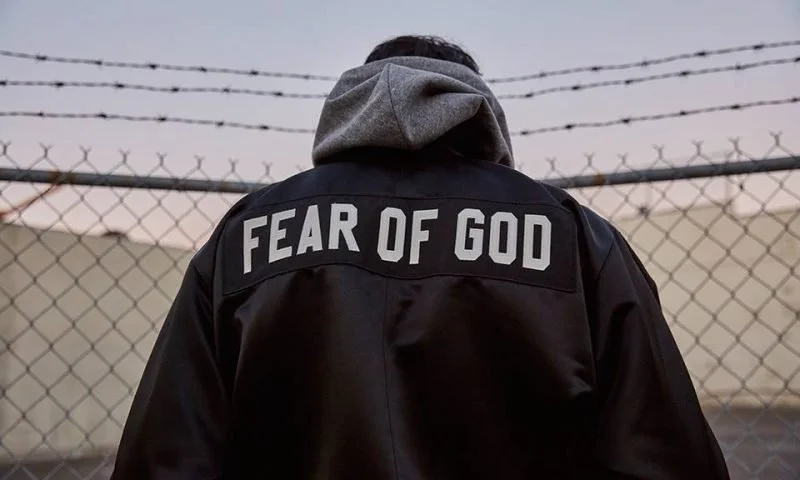
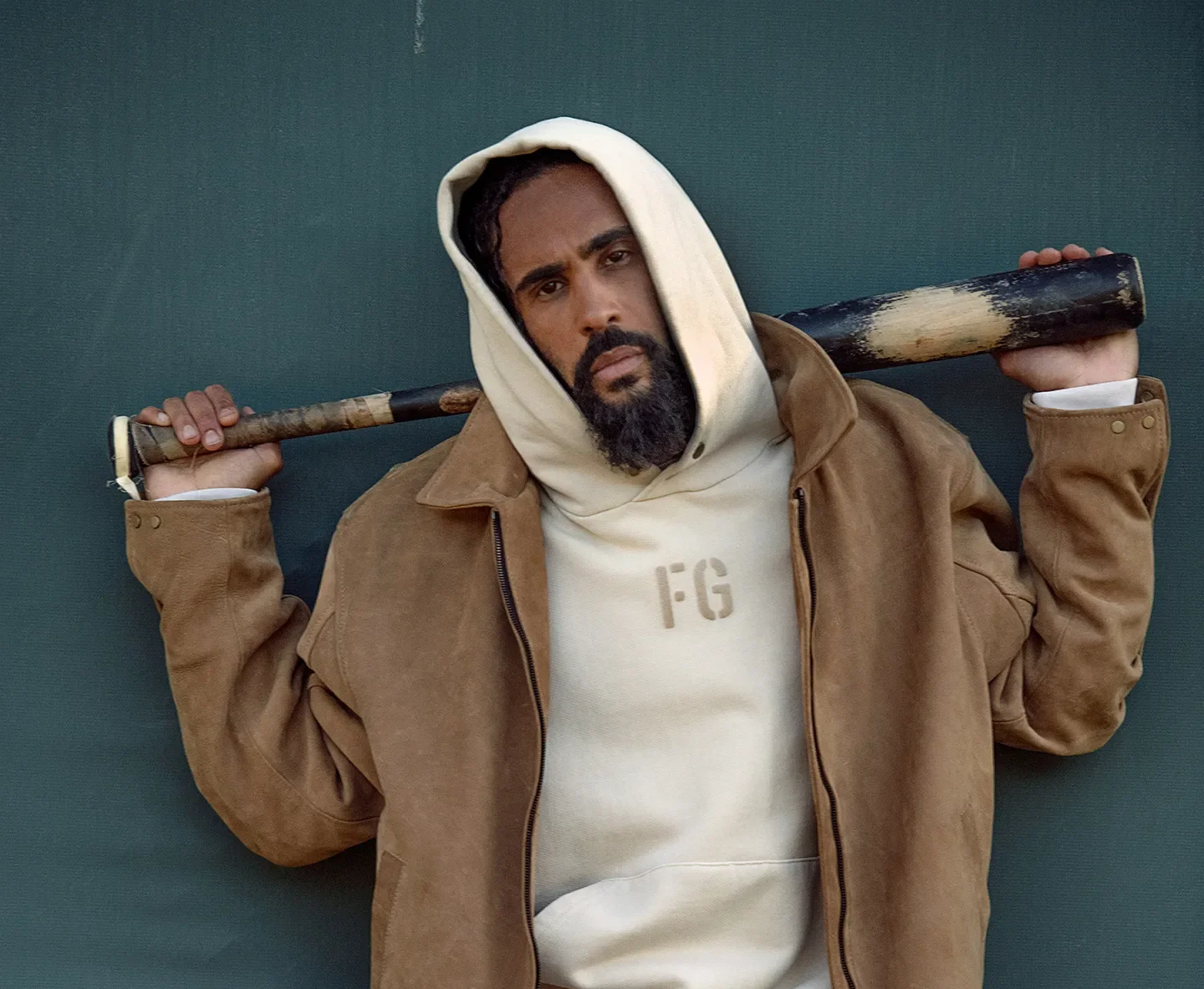
Jerry Lorenzo
The young man was aware of the brand positioning of Fear of God, although his parents were not. Cool, but not cheesy. Strong, but not combative. Young men have been flailing for several decades, called the oppressor and told their masculinity is toxic, yet feeling without hope or a future. Some are turning to God to find purpose and grounding. This is the moment we are in, and as one of the country’s leading religious demographers, Ryan Burge, noted: “We’ve never seen it before.”
The statistics are familiar at this point, and the contrast with their female counterparts is even more stark. As one writer observed: “You and your friends were unmotivated in school—on pace to earn less than half the college degrees, to die by suicide at four times the rate, and to be incarcerated 14 times more often than your female counterparts.”
Richard Reeves left Brookings several years ago to take up the challenge of advocating for a generation of disenfranchised boys, and for investments, both private and public, to address their particular challenges. Reeves’ American Institute for Boys and Men (AIBM) conducts non-partisan research on issues that affect the well-being of boys and men across the United States, and designs programs and policies to help them thrive. “We envision a nation where all boys and men are supported in realizing their full potential and are celebrated—in their families, workplaces, and communities—for their unique talents and contributions,” Reeves’ effort states.
As AIBM’s research and writing point out, boys in particular are detached from the institutions that create social cohesion, foster well-being, and promote purpose. They have not had the social and cultural affirmation that young girls have received in recent decades, and worse – those from lower-income, less educated homes and communities often believe they are the oppressed not the oppressors, powerless and without agency. It is from this vulnerable place that some turn to gangs, some to the military, and some to online toxic communities that can lead to radicalization.

Nick Fuentes and followers
Terms like “incel” (involuntary celibate), “Groyper” (followers of Nick Fuentes) and “RadTrad” (radical traditionalists) have become common in our lexicon. Young men are exposed to the aggressive and often verbal violence of online social media, sadly validated by our national, cultural, and political leaders.
The turn toward organized religion among a demographic suffering from the disorientation left by the deconstruction of almost everything once considered certain is not entirely surprising, but the challenge is to ensure that they are well discipled by the religious leaders they are turning to.
In its lengthy feature entitled “Orthodox Church Pews Are Overflowing With Converts”, The New York Times noted that “across the country, the ancient tradition of Orthodox Christianity is attracting energetic new adherents, especially among conservative young men. They are drawn to what they describe as a more demanding, even difficult, practice of Christianity. Echoing some of the rhetoric of the so-called manosphere, new waves of young converts say Orthodoxy offers them hard truths and affirms their masculinity.”
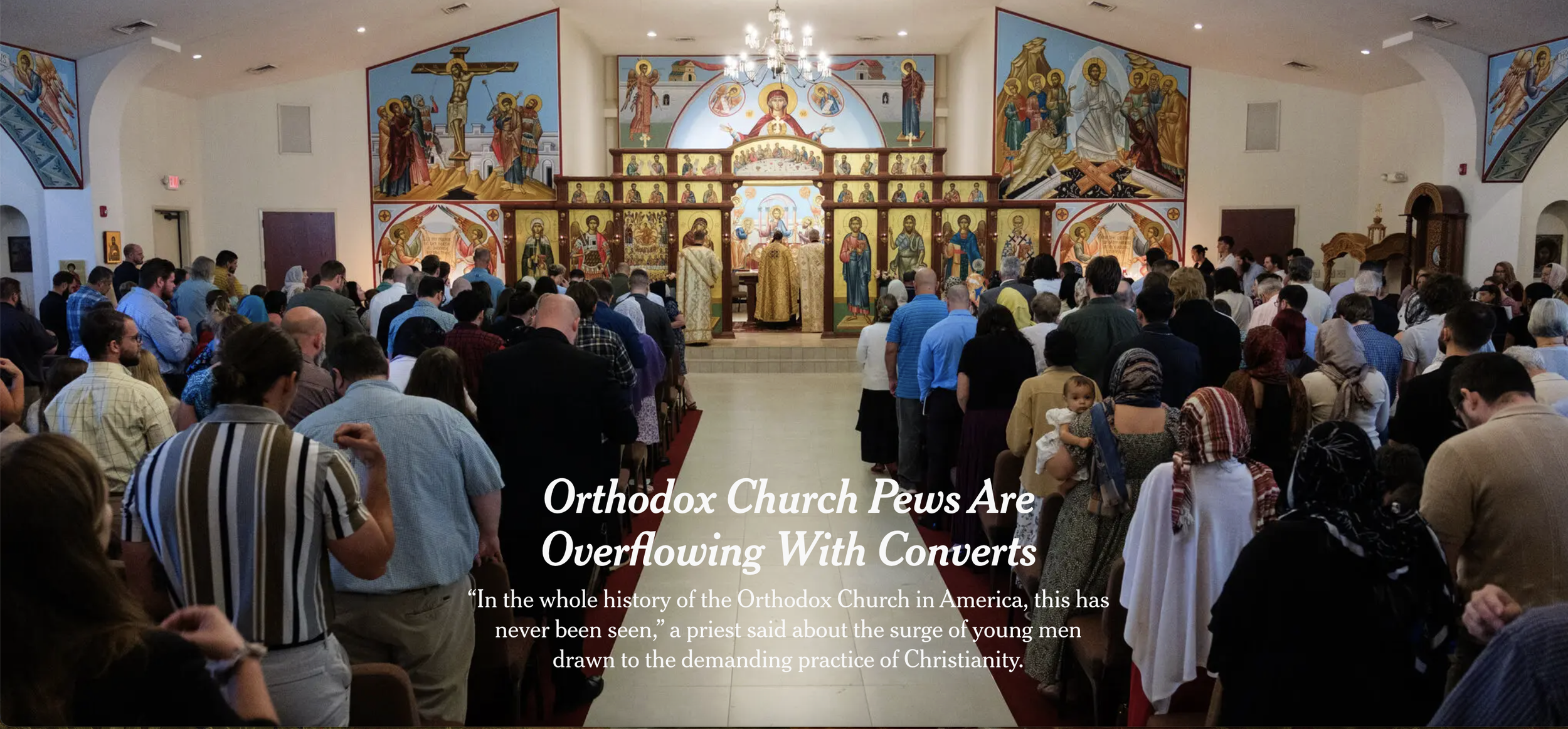
“In the whole history of the Orthodox Church in America, this has never been seen,” the Very Rev. Andrew Damick, an Antiochian Orthodox priest and author in Eastern Pennsylvania, said of the large groups of young people showing up at many parishes: “This is new ground for everyone.”
I can anecdotally validate this. A few weeks ago, I was in Nashville for a screening of our sister company More Productions’ short animated film The 21 at Belmont University, with and for the local Coptic Christian community. I met the pastor of a recently established Coptic church, their 18th in the region, dedicated to non-Egyptian converts, mostly young men.
As we noted in our post after Charlie Kirk’s assassination, this wave of spiritual interest has been coming for several years, but it has certainly crested in the last several months, at least in terms of news coverage. As the Barna Group noted in a recent release, “For the first time in decades, younger adults—Gen Z and Millennials—are now the most regular churchgoers, outpacing older generations, who once formed the backbone of church attendance.”

From a public policy perspective, this turn of events has an outsized impact in mitigating some of the worst self-harm that this generation is experiencing. However, while listening to the podcast Pints With Aquinas with Matt Fradd and writer and cultural commentator Rod Dreher, I noted Dreher’s observation that many of the young men turning to orthodox religion are bringing their aggressive and sometimes belligerent personas with them. “It’s as if they have to be ‘deprogrammed,’” Rod said, to ensure that they engage people they differ with in a Christ-like manner. They aren’t taught to “love their enemy” online.
If these young men are discipled by online agitators like Nick Fuentes, we are in for some rough roads ahead. But if they are discipled by religious leaders to “love God and love your neighbor,” then we can hope to see not only their lives improved, but for them to be healing agents in society overall.
In addition to working with Coptic Christians, an orthodox community, More Productions has also supported a scripted feature film El Tonto Por Christo (A Fool For Christ), beautifully filmed and produced by Orthodox filmmakers from Texas. The story takes place in a monastery, and although an art-house film in black and white, it reminds us that Christians are not “of this world,” that although they live in it, they should not be overly entangled in its affairs, at least to the point of being consumed or identified by them.
The Christian virtues of self-sacrifice, radical love, protecting the innocent and weak, showing grace and mercy, and living in service to God and others are ways to channel the energy of these young men, and hopefully lower the temperature of the aggressive and at times violent culture war they have found themselves in.
In his recent Free Press essay “J.D. Vance Versus the Groypers?”, Rod Dreher noted that “the most effective weapon against Fuentes-style despair was Charlie Kirk. He tried to give his generation of conservatives a positive, life-giving way through the trials of their age: through God, family, and a moral commitment that did not demonize the opposition, but rather tried to reason with them. Kirk was resolutely opposed to both Fuentes and antisemitism, and was constantly trolled by Groypers for his efforts.”
Rather than seeing a turn to religion as a possible road to radicalization, as some on the secular left might do, this moment will benefit from thoughtful, facilitated conversations between religious leaders, policy makers, civil society leaders and foundations to encourage this re-attachment to institutional religion.
It’s a good thing when socially isolated young men start to shift their focus from fighting online to Fear of God.
I’m not trying to come into a room and be the best dressed, but I also have a level of respect and honor for myself that I am going to carry myself in an elegant way. There’s something about Christianity that is humble and chic, it’s someone who’s the quietest in the room, but their character is the loudest because of the integrity that they walk in. It’s this balance of the two worlds that represent, in my opinion, the best of us. – Jerry Lorenzo