
Motherhood is a Sacred Calling. Caring for Moms is a Sacred Responsibility.
Before I had children, I would bristle when moms would say they had the hardest jobs or that motherhood was a high calling. It felt manipulative, as though childrearing was a woman’s primary role and everything else she did was tangential.
But then I got pregnant with my first son. I didn’t even know this kid, but here I was enduring brain fog, nausea, the aches and pains of my body changing to accommodate him (without the help of Advil) and eight weeks of insomnia in my third trimester. And I also had to–temporarily–give up coffee and peace of mind when it came to eating certain food or even taking a warm, relaxing bath. All of it for him. I was only about halfway through my first trimester when I tearfully called my mother and apologized for being such a sassy adolescent.
I hadn’t even given birth, and I knew that motherhood truly was the weirdest, hardest, and most sacred job in the world. For a follower of Jesus like me, motherhood was a daily invitation to become more like Christ by sharing in his sufferings as well as his glory.
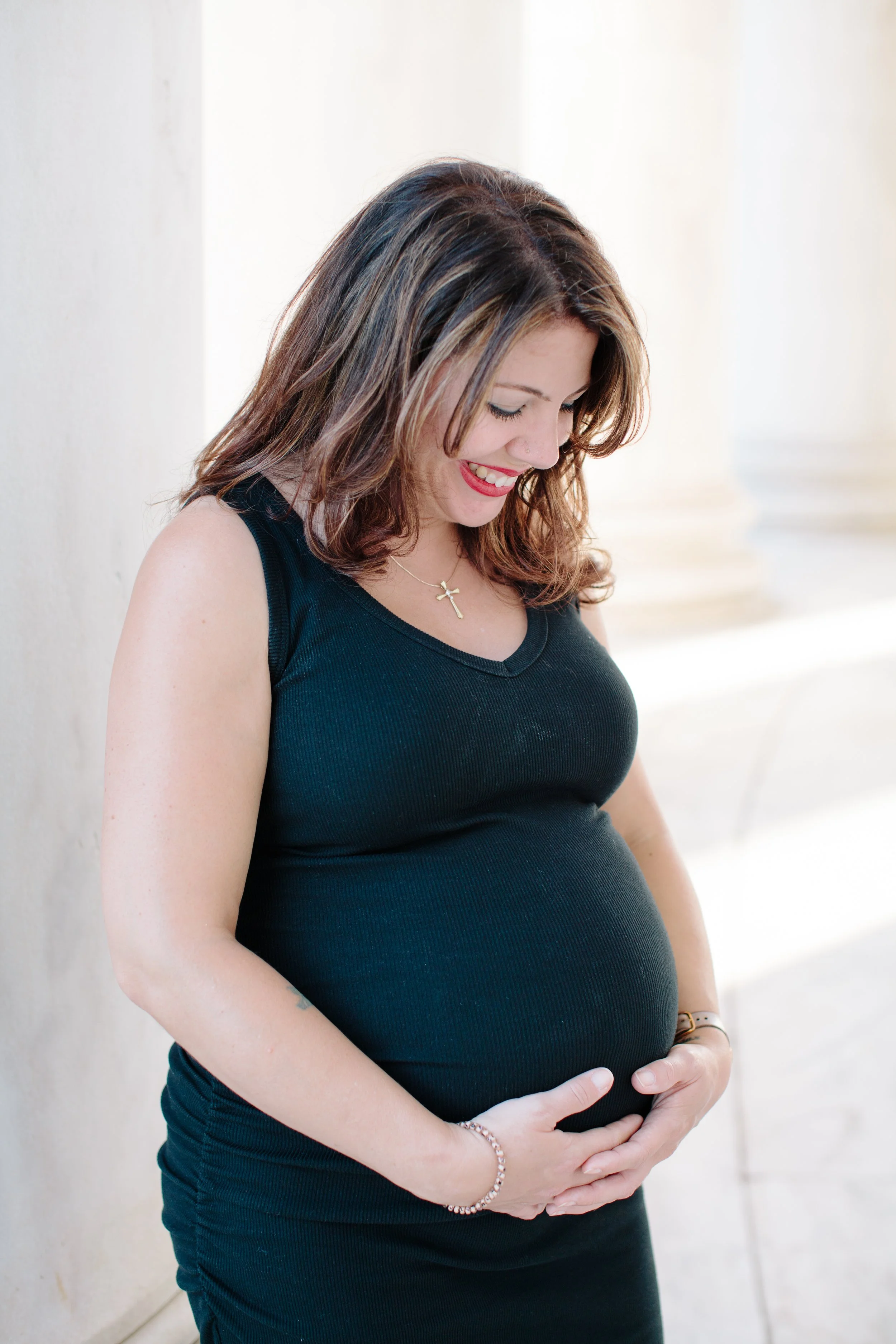
Whitney Porter Photography
Mother’s Day is perhaps one of the only days it is ok to talk about God’s motherhood, because what the nurturing God does in scripture is very motherly. You know who mostly doesn’t slumber or sleep? Moms. You know whose ears are attentive to their children’s cries? I can hear my baby stirring from three floors away. We should all feel incredibly reassured when scripture says, “Can a mother forget the baby at her breast and have no compassion on the child she has borne? Though she may forget, I will not forget you!” Because nursing moms plan their entire day–outfits and all–around feeding their babies and then at night look at pictures of the babies they spent most of the day holding.
So when I became pregnant with my third son, I was already well acquainted with the high calling of motherhood (and at 43, had insanely opted to do it all over again). But I didn’t expect God to ask me to risk my life for that child.
At our seven-week pregnancy appointment, we discovered that our son was implanted inside my C-section scar tissue. These types of pregnancies are incredibly rare (though becoming more common) and are technically ectopic. This news was devastating. We had experienced three pregnancy losses after my second son was born and at my age, I knew my childbearing days were numbered. We were sent to the ER and were told by a doctor that the pregnancy was completely non-viable. We’d have to terminate it, because I was sure to rupture and die.
Two days later, I spent part of my 44th birthday at Johns Hopkins Center for Fetal Therapy, praying that there could be some way I could keep this baby. Even though I didn’t know my son, I loved him and after losing multiple pregnancies, I couldn’t bring myself to terminate if there was even the smallest chance we could both make it out alive.
We were told we could continue the pregnancy, but it would cost me my fertility. I would not be able to go past 34 weeks and at some point, I would have to move into Johns Hopkins in Baltimore, MD to be close to a blood supply in the event of a rupture (I live an hour away).
At my 12-week appointment, our surgeon advised me to get my affairs in order. At 23 weeks, I moved into the antenatal wing at Hopkins, leaving behind my husband and seven year-old and four year-old sons.
Throughout the loneliness of my time at the hospital and the constant parade of doctors and surgeons coming to my room to inform me of some new potential horror I could endure, I kept thinking of a particular scripture from the New Testament book of Hebrews:
“...let us run with perseverance the race marked out for us, fixing our eyes on Jesus, the pioneer and perfecter of faith. For the joy set before him he endured the cross, scorning its shame, and sat down at the right hand of the throne of God.” - Hebrews 12:1b-2
Though the cross I bore was not shameful, it was heavy and felt covered in splinters. I wept every night, imagining my husband having to tell my boys that I was dead and not being there to comfort them. Yet I felt so much joy whenever I would feel my son’s kicks or hear the thrum of his heartbeat during our daily monitoring.
My surgery was moved up to 27 weeks. The night before, while hooked up to a magnesium drip and prepared for surgery, I had a small taste of Jesus’ grief in Gethsemane. I knew that I had chosen to drink this cup, and I trusted that God would take care of my family and me. But I also knew that God’s ways and plans don’t always make sense.
My son Ronen (“Joyful Song” in Hebrew) was born at 27 weeks and 2 days, weighing 3lbs and measuring 15”. I made it through surgery in a day (rather than two) and barely needed any blood for resuscitation. Instead of recovering in the SICU, I recovered in Labor & Delivery and went home four days later. My son left the NICU after nine weeks and has been perfectly healthy ever since. The joy of being alive every day with him is worth all of the suffering I had to endure to get us here. And it brings me so much more joy to realize that is how Jesus feels about you and me.
My story had a happy ending (and new beginning), but for a lot of women that’s not the case. I had access to excellent care in Washington, D.C., but still had to move an hour away to be treated by one of the only doctors in the country who can do these types of surgeries. There are so many other moms–who also, for the joy set before them endure high risk pregnancies–who don’t make it home to their children. They live in low-income or rural communities and cannot get the kind of care I received, as early as I received it.
Beyond high-risk pregnancies, moms across the country are at risk of death either from childbirth or in the crucial postpartum period. Since the early 1980’s, maternal mortality in the United States has more than doubled. Of all the developed countries, we have the worst maternal death rate, but 87% of those deaths are preventable. Those rates are even worse for Black and Indigenous mothers. Most moms, no matter their income, get one postpartum check-up at six weeks, and during that time a mother experiencing postpartum depression, anxiety, or psychosis could take her own life.
While many communities don’t have birthing centers or hospitals, they do have houses of worship. I was fortunate enough to be supported by my Anglican church and by the Jewish preschool my middle son attends. Faith communities are uniquely equipped and called to support mothers during and after pregnancy–and so many do this through providing meals, childcare, prayer, and counseling. But faith communities can also do more. We can train congregants to become doulas or recruit trained volunteers to do home visits.
Faith communities can also use their voices to advocate for moms. Working with Healthy Moms, Healthy Babies America, we are publishing an open letter signed by a diverse and bipartisan group of faith leaders, affirming the high and sacred calling of motherhood and acknowledging that faith communities should lead when it comes to caring for America’s mothers.
Motherhood asks us to lay down our lives for our children before we even know them. But while Jesus was called to die for the sake of humanity, mothers are called to live and raise their children. This Mother’s Day, let’s make sure every mom can live to celebrate with her family.
An excerpt from “Faithfully Supporting Moms and Babies, An Open Letter By Faith Leaders On Mother’s Day 2026:”
“Dear Mothers of America,
…The reason for our nation’s high rate of maternal mortality is multi-pronged, but we believe our faith communities must be part of the response. While not every community has obstetric care, most have a house of worship or faith group. We can answer our sacred call to honor mothers during the inevitable vulnerabilities and sacrifice that pregnancy brings by serving as conduits of tangible support, particularly in the postpartum stage when the risks are the greatest…”
Read the full letter and view the list of 33 faith leaders from across the country who have signed.
